

|
|
|
|
| Parts | Services | Tools | About | Contact |
| The First Reports of Rudder Cracks (1989) |
| In 1989 the Airline Training Center in Tucson contacted Beech with the news that one of their fleet of 15 F33As had a broken rudder. That is, the upper hinge had torn out the portion of sheet aluminum spar to which it was attached. Later the ATC found five more rudders in their fleet that were progressing to failure, with cracks under the upper hinge and some under the middle hinge. Then the FAA passed on two “Malfunction or Defect" reports describing the same problem on an F33A and a 35-C33A. Thus a total of eight partial failures had been discovered out of a sample of 17, and there were about 4,300 Bonanzas out there with the same rudder design. The above is taken from a Beech "Staff Study" dated September, 25, 1991. |
|
|
|
|
| The Hardware |
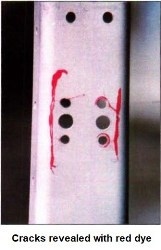
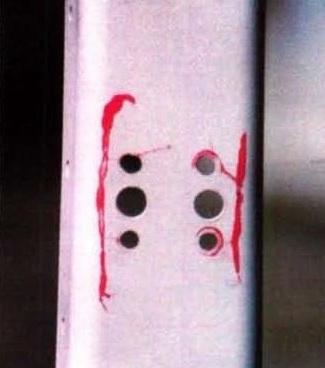
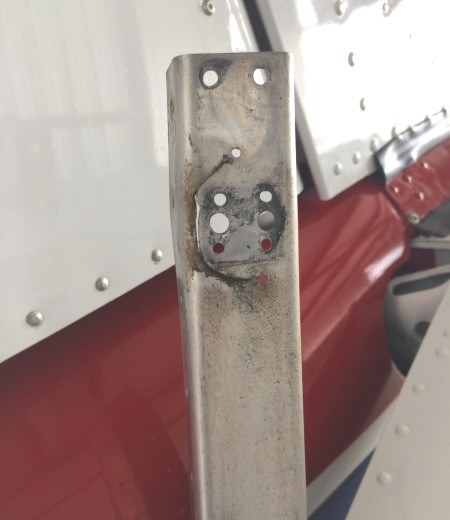
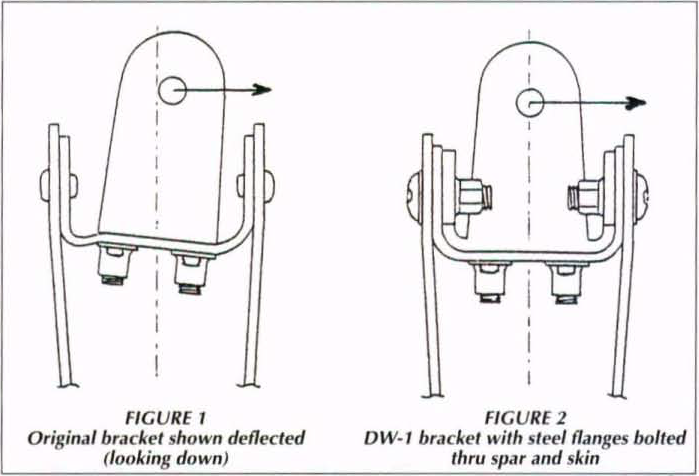
| The rudders of Bonanza Models 33 and 36 are hinged at three places: top, middle and bottom. The top and middle hinge brackets are attached to the spar web with two screws and nutplates (see Fig. 1, top bracket at end of page). The web is rocked left and right by the hinge load, resulting in fatigue cracks at various locations as shown in the photo of a dye-penetrant inspected spar. The glaring problem with this design is that the hinge bracket is mounted on a trampoline. The integrity of this vital attachment depends on the out-of-plane bending strength of a 0.6-inch square of .032" sheet aluminum bounded by the six nutplate holes. The upper hinge is in a tight spot, out of sight and inaccessible. Inspection of the failed area is only possible by removing the rudder and the two safety-wired screws that attach each bracket to the spar web. Beech estimated the disassembly, inspection and re-assembly to require four man-hours. |
|
|
| The Mandatory Service Bulletin |
| Beech performed a "statistical study" of the 17 inspected aircraft. The eight cracked rudders had flown between 1,200 and 5,000 hours each. This tiny sample became the basis for Mandatory Service Bulletin No. 2333 issued in October 1989 to owner/operators of about 4,500 Models 33 and 36s that were currently flying with the same rudder hinge supports. The MSB warned that these partial failures “could result in loss of airplane control.” For aircraft with more than 1,000 total flight hours, it called for dye-penetrant inspections of the rudder spars within 50 flight hours and at every annual thereafter or at 500 flight hours, whichever comes first. The lowest flight time in the sample of eight cracked rudders was 1,200 hours and from this it was reasoned that the other 4,500 flying rudders would be safe for the first 1,000 flight hours! |
|
|
| The follow-up AD and Revisions |
| Eight months later, the FAA
published an Airworthiness Directive (90-11-04) on the subject. For
aircraft with more than 1,000 flight hours, it called for an inspection
of the spar within 100 flight hours and at every 500 flight hours
thereafter. Three more ADs followed: 91-23-07, 92-15-06 and 93-24-03, with the same inspection schedules. Thus the AD left out the annual inspection requirement of the MSB. To illustrate the danger in this omission, an aircraft that averages 100 hours per year must be inspected for spar cracks in 11 years since new and again five years after that! This even applies to the acrobatic Bonanzas (Serial CJ-1 through CJ-179) that are type-certified to do snap rolls. The significance of "500 flight hours" changed radically between the MSB and the AD. Beech requires 500-hour inspections for aircraft flown more than 500 hours per year, and annual inspections for the rest. The FAA only requires 500-hour inspections in five, 20, 30 years—whenever. This discrepancy was clearly an error in the AD. The FAA backed off slightly with a recommendation in Special Airworthiness Information Bulletin No. CE-00-21 and also in a letter to Dick Wilson stating "MSB 2333 requires annual inspections” (per CFR 43.13). In other words, the FAA says you must inspect the rudder annually, until you fix it, regardless of the terms of the AD. Who is in charge? The rudder spar failures are caused by a mysterious magnitude-frequency spectrum of rudder pedal forces. No one has any idea of how to specify a safe spectrum or to predict when it will be exceeded. Yet the FAA says, in effect, that regardless of previous and future loads, an incipient crack cannot proceed to a catastrophic failure within 500 flight hours. Calendar years should be taken into account: corrosion can extend cracks in sheet metal subjected (improperly) to out-of-plane bending. The hinge opening is exposed to the weather, and the surface between the bracket and the web can retain water. The bracket and spar are of dissimilar metals, which makes corrosion more likely. |
|
|
| The production line mod |
| Shortly after the discovery of the rudder problem, Beech devised a repair for rudders not yet assembled to avoid building more aircraft with known flaws. This consisted of internal reinforcements to the aft side of the spar at the two hinge locations. The spar web would still be rocked back and forth, but not as much because it was stiffer. To be sure that the changes prevented the cracks and didn't cause new failures, 1.5 inch holes were cut in the rudder skin aft of the hinges so the interior could be inspected with a mirror and flashlight for possible continued cracking. And because the holes reduced the buckling strength of the rudder skin at the points where the stresses are greatest, the skin was reinforced near the holes to prevent the holes from causing buckling or wrinkling. The inspection became an annual requirement for the new rudders with this redesign. |
|
|
| The SMP Hinge Brackets |
| In August 1990 STC SA4899NM was issued for the upper reinforcement bracket SMP-1. It was a welded four-piece "addon” which straddled the original crack producing bracket, leaving it in place, but carrying all of the hinge load out to the attachments of the spar flanges to the skin. This "belt and suspenders" design was hard for the FAA to reject, and two years later, in August 1992, AD 92-15-06 was issued which called for stop-drilling of any web cracks, and permitted the end of the AD inspections if an SMP-1 hinge bracket was installed. Approvals for the SMP-2 Middle Hinge Bracket followed with AD 93-24-03, the latest and current AD. |
|
|
| MSB #2333 Rev. 1 - Field Repair |
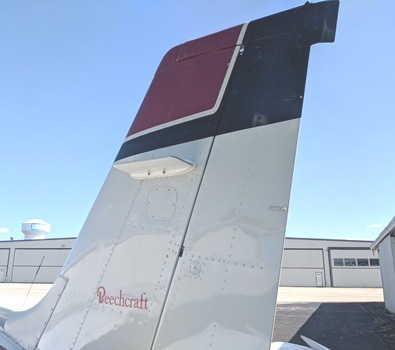
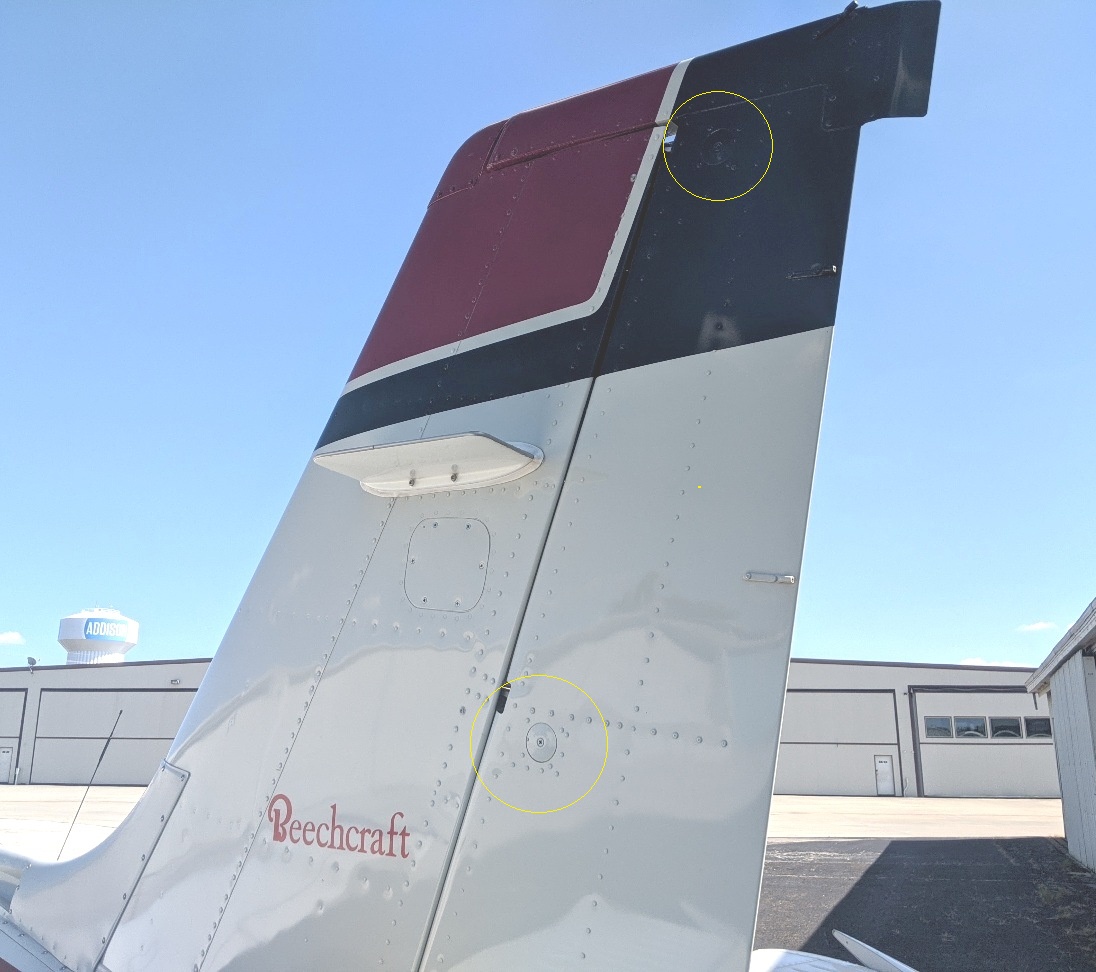
| In November 1991, Beech published MSB 2333 rev1 to introduce Kit No. 33-6001-1 S for strengthening the rudder spar on aircraft in the field and ending the previous disassembly dye-penetrant inspection requirement. This kit was essentially the reinforced spar of the “production line mod” described previously. Beech estimated 29 man-hours to install it, and a hardware cost of $4,339.94 (as of 05-2026) but this assembly is tricky without factory tooling and experience. Annual inspection through the skin holes for possible future cracking is required. The MSB offers an alternative fix: an expensive new rudder which must be painted and balanced. (no price or availibility at Textron as of 05-2026) |
|
|
|
| The new DW-1 and DW-2 brackets |
| In March 1996,
STC SA00044LA was
granted for the much-improved DW-1 and DW-2 brackets. They are installed
in the same manner as the Beech brackets (two existing screws), but with
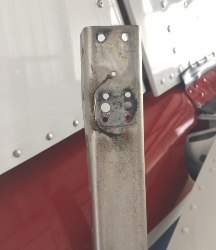
additional screws which replace skin rivets. The DW-1 is illustrated in
Fig. 2 at the bottom of the page. The FAA grew tired of issuing rudder crack
ADs so they approved the “equivalence” of the new DW-1 and DW-2 with a
letter which is included with the kit documents. This approval is also
covered by Special Airworthiness Information Bulletin No. CE-00-21. The
SMP brackets are out of production and were superseded by DW brackets in
1996. The DW-1 and DW-2 were manufactured and distributed under PMA by
General Forming Corp. in Torrance, California. There are about 4,300 affected 33s and 36s in the US
Registry, and about 60 percent of them have been fixed with SMP or DW
hinge brackets. Of these, over 100 kits were shipped to Beech (Raytheon)
facilities. The affected aircraft, as listed in AD 93-24-03 are: CD-I through CD-1304 CE-1 through CE-1425 CJ-1 through CJ-179 E-l through E-2578 EA-1 through EA-500 |
|
|
| Easy identification of repairs |
| Rudders repaired with SMP or DW hinge brackets have four steel screws replacing rivets at the top hinge (see Fig. 2 below). Most of these also have two screws at the middle hinge. Inspections are no longer required. Rudders repaired with the Beech Kit 33-6001-1 S have two 1.5 inch diameter holes cut in the skin on one side just aft of each hinge. These holes are covered with steel caps. MSB 2333-1 requires that rudders repaired with the kit be inspected annually through the holes for “attachment security and cracks.” |
|
|
| SUMMARY: Four choices for unfixed aircraft |
| 1. The FAA is not going to tighten
the AD rules until an alarming incident or accident is revealed to the
FAA. Until then, unless you have cracks, it is legal to reinstall the
old brackets after inspections. 2. Install a DW-1 Bracket to end future inspections, which would cost at least $500 each. While the rudder is off, it is best to also replace the middle bracket with a DW-2. This may become a requirement in a new AD. Cracks are OK at both locations; just stop-drill them. To end the danger and expense, it is strongly recommended that the old brackets be replaced at or before the next annual. 3. Replace the spar with the reinforced spar kit, hardware cost $4,339 (as of 05-2026). Repaint and balance the rudder and reinstall. Shop hours: about 29. Continue annual inspections for possible future cracks. 4. Order a new rudder from Textron, paint, balance and install. Continue annual inspections for possible future cracks. (No stock or pricing at Textron as of 05-2026) |
|
|
 |
|
|
| Dick Wilson | Space Machine Products | General Forming Corp | Charles Vegher |
| Dick Wilson
was a highly regarded strength engineer at Douglas Aircraft from 1942
until 1977 and owned a Debonair at the time the rudder spar cracks were
discovered. He thought the inspection procedure required by the AD
introduced numerous opportunities to damage the rudder and/or vertical
stabilizer so when the AD came out he analyzed the vertical stabilizer
rudder hinge attach points to determine if there was a simple fix. He
concluded that a reinforcing bracket for the upper and lower hinge
attach points would reduce the stresses to the spar and eliminate
cracking so that no future inspections would be required. The FAA agreed
and issued STC SA4899NM approving his design and installation of
first-generation brackets which he had manufactured by Spacecraft Machine
Products (SMP) in Torrence California and accordingly, SMP and STC SA4899NM are noted in
paragraph (b)(3) of the AD. Installation of the brackets became listed
as an Alternate Method of Compliance (AMOC) that eliminated the need for
future inspections. SMP ceased operations around 1996 so, Mr. Wilson redesigned and improved the brackets and had them manufactured and sold by General Forming Corp also in Torrence, CA. under new part numbers DW-1 and DW-2 per STC SA00044LA. General Forming Corp was then owned by Charles Vegher and the two became friends. Prior to his passing around 2010, Mr. Wilson transferred rights to the STC to Mr. Vegher and General Forming Corp continued to manufacture and sell the brackets. Mr. Vegher sold General Forming Corporation around 2015 but under a personal agreement, they continued to manufacture the brackets which he started selling to the public directly. In August of 2025, Mr. Vegher agreed to sell the STC rights to Shep Johnson and BBD Aero LLC was formed. Most of the information on this page was written by Mr. Wilson and originally published in the American Bonanza Society magazine in 1997 and again in 2001. Additional information was added as gathered from several conversations with Mr. Vegher and additionally obtained while researching the AD for my own F33A Bonanza. As owner of one of the affected models, I wanted to become the next caretaker of this STC to ensure these important parts continue to be available to address this critical AD. |
|
|
| (back) |
 |